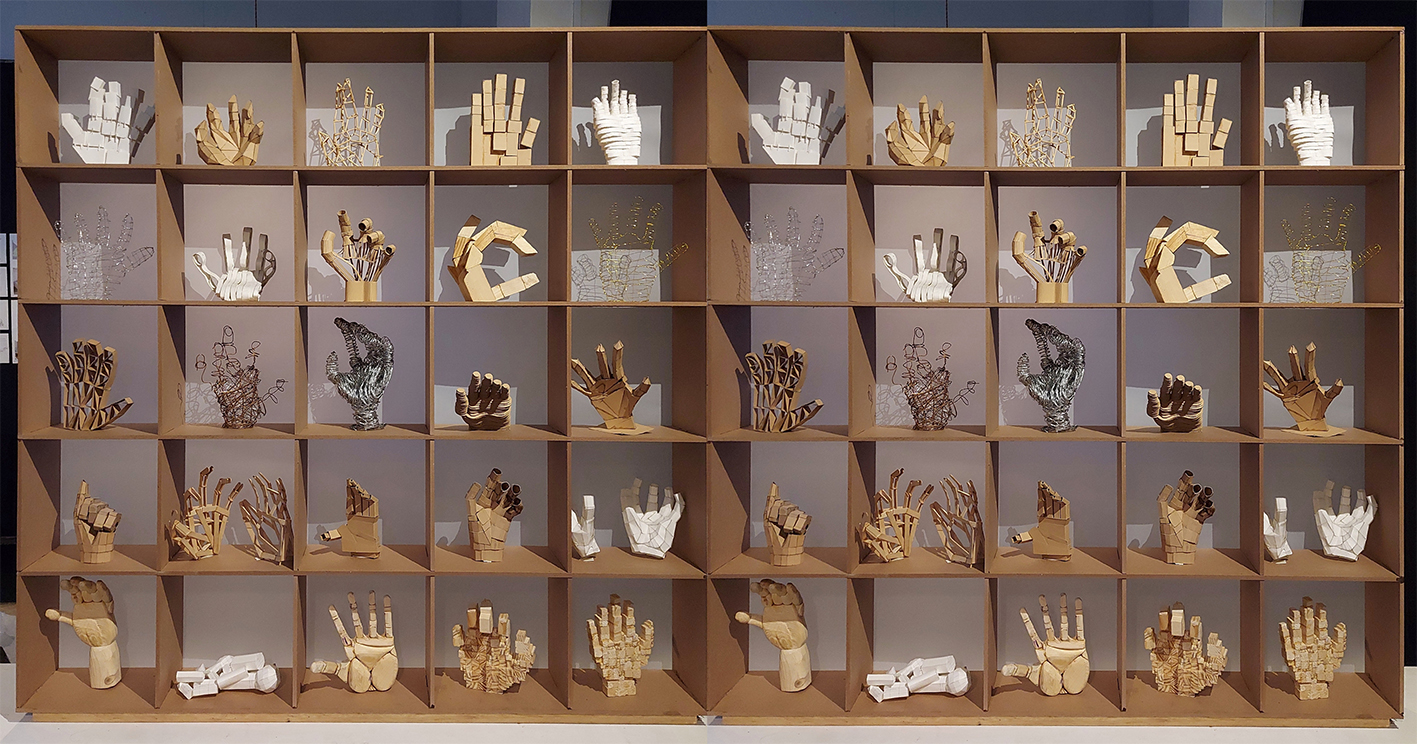

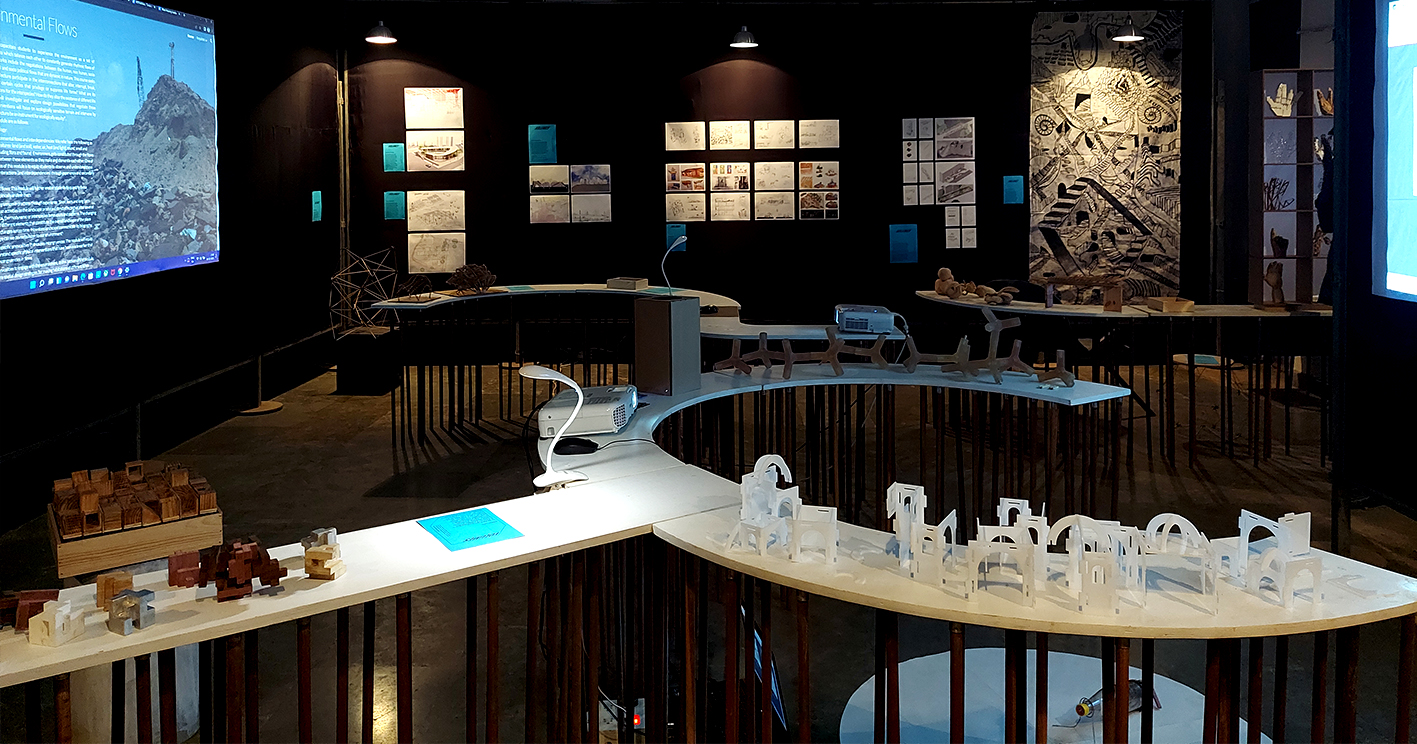


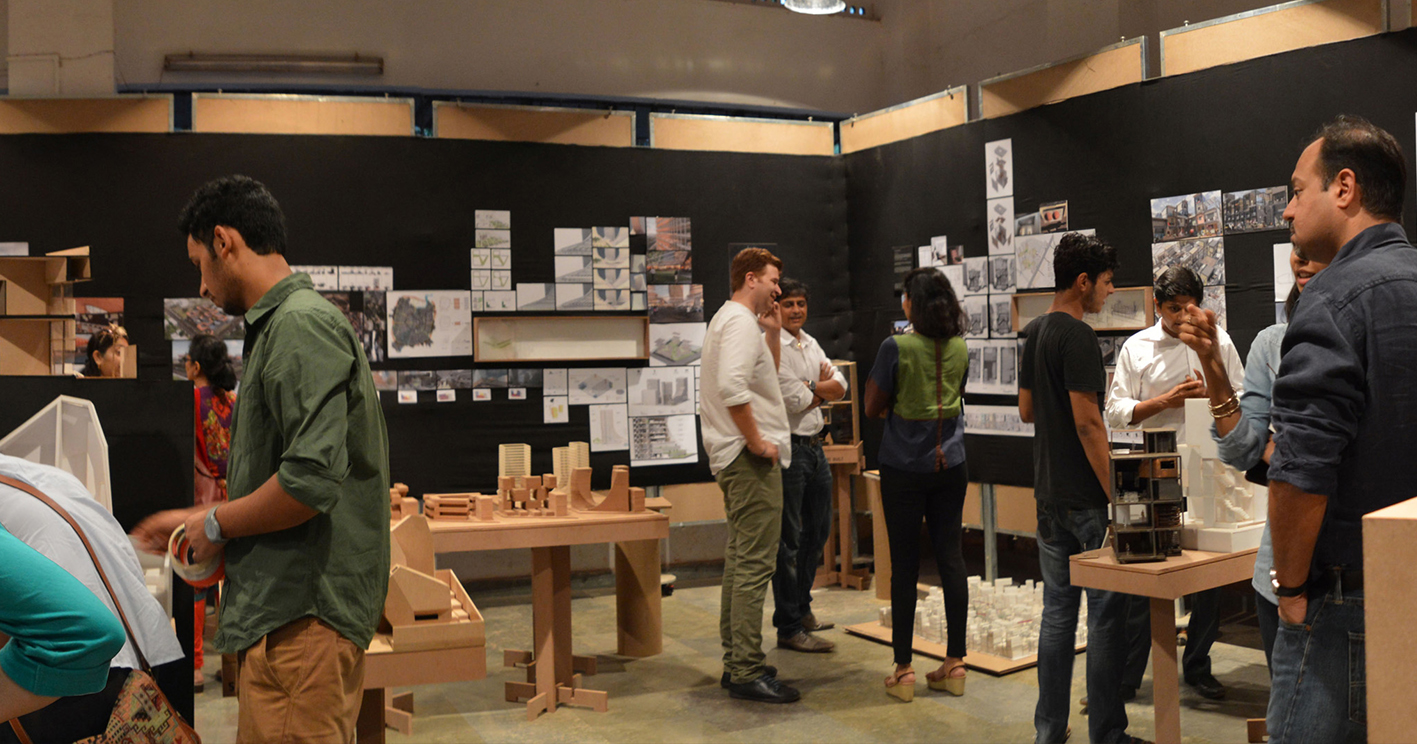
SEA CITY is the School of Environment and Architecture’s outreach programme. SEA City organizes events, lectures, symposia and exhibitions in order to engage with the larger artistic and cultural discursive sphere within and outside the city. SEA City events are completely open to all public, and are attended by a diverse group of people including students, architects, professionals, academics and locals.
PROJECTIONS: ANTICIPATION AND ARCHITECTURE
This season’s conversation series Projections: Anticipation and Architecture delves in the discipline’s engagement with imagining futures. In exploring how architecture, and more broadly spatial practice, engages anticipation in envisioning futures, we ask: What forms of spatial and design thinking, and practices of hope, emerge when anticipation is understood as a widely distributed and negotiated capacity in turbulent worlds marked by deepening difference, colliding forcefields, uneven distribution of harm and risk, instability, uncertainty and fragility? How do architectural practices frame futures prospectively or retrospectively from the sociospatial conditions in which their projects are situated? These questions privilege as well as bring into conversation both research- and practice- based perspectives on the making of futures in this series.
sessions
July 10, 2026- Dushkaal: Reframing time and futurity in the climate crisis
July 24 , 2026- Migration, Material, Memory
August 08 , 2026- a Sphinx, a Cormorant & other Forests Geographies of Imagination in participatory practices
August 21 , 2026- One Thing Led to Another
September 04, 2026- Elemental Coalitions
October 09, 2026- Look, Find and Play
October 23, 2026- Affordances and Interventions: Creating Infrastructures of Conviviality and Care (upcoming)
sessions
July 10, 2026- Dushkaal: Reframing time and futurity in the climate crisis
July 24 , 2026- Migration, Material, Memory
August 08 , 2026- a Sphinx, a Cormorant & other Forests Geographies of Imagination in participatory practices
August 21 , 2026- One Thing Led to Another
September 04, 2026- Elemental Coalitions
October 09, 2026- Look, Find and Play
October 23, 2026- Affordances and Interventions: Creating Infrastructures of Conviviality and Care (upcoming)


session 7
Affordances and Interventions: Creating Infrastructures of Conviviality and Care
Friday, 23rd October 2026,
5 pm to 7 pm
VENUE
School of Environment & Architecture
CKP Colony, Eskar Road, Borivali West, Mumbai 400 091
or join virtually via YouTube Live
Both affordances and interventions can potentially generate hospitable spaces and new forms of sociality, but as remedial or expansive gestures, they often get sucked into the quagmire of socio-economic asymmetry or are neglected by a dominant calculus of utility. And, on occasion, affordances and interventions can coincide or dovetail. Typically but not necessarily, affordances tend to be more intimate in scale and call for minimal, often behavioural change, while interventions could vary in scale from the intimate to the monumental, and might call for major, often structural change.
discussants
Nancy Adjania
Nancy Adajania's paper will address these moments in capacity evolution by reference to such case studies as the MP Tribal Museum, Bhopal; the National Gallery of Modern Art, Mumbai; JSW School of Public Policy at IIM Ahmedabad and the Dialogue Centre in Kondagaon, Chhattisgarh, among others.
Nancy Adajania is a cultural theorist and curator based in Bombay.
moderated by
Rupali Gupte
(SEA)
This lecture series is partially supported by Urban Centre Mumbai and is free and open to public.
discussants
Nancy Adjania
Nancy Adajania's paper will address these moments in capacity evolution by reference to such case studies as the MP Tribal Museum, Bhopal; the National Gallery of Modern Art, Mumbai; JSW School of Public Policy at IIM Ahmedabad and the Dialogue Centre in Kondagaon, Chhattisgarh, among others.
Nancy Adajania is a cultural theorist and curator based in Bombay.
moderated by
Rupali Gupte
(SEA)
This lecture series is partially supported by Urban Centre Mumbai and is free and open to public.


session 5
Elemental Coalitions
Friday, 04 September 2026,
5 pm to 7 pm
VENUE
School of Environment & Architecture
CKP Colony, Eskar Road, Borivali West, Mumbai 400 091
or join virtually via YouTube Live
The grass genus Tripogon flourishes on the ledges of an abandoned basalt quarry. Its three apical awns effectively self-cultivate by drilling themselves into the soil. The awns make the grass tentacular, creating attachments and detachments. As it finds shelter in rock crevices and moves along available surfaces, the grass feels its way to situate itself, weaving networks with the terrain. It does not know where and how it will end up; it is open to possibilities. These acts of detachment and attachment are an outcome of an ongoing practice of what Haraway calls “collective knowing and doing.” Highlighting such stories of elemental coalitions in a ruin, the talk shares an actionable vocabulary for architects to response-ably build in the ongoing regimes of climate crisis.
discussants
Sonal Mitthal
Sonal Mithal (she/her) is an architect, artist, and educator. She is co-founder of research and conservation studio, People for Heritage Concern. She serves as Chair of the Masters in Conservation and Regeneration program at CEPT University. Her practice, teaching, and writing transects architecture, landscape, queer studies, history, and conservation. She is invested in research-based artistic practice informed by systematic archival inquiry, political critiques, and design environments integrating contemporary ecological factors. She has produced large scale artworks for the Ahmedabad and Surat Metro stations that visualize lesser-known histories of the cities through rigorous archival research Her artwork, Matter in the Future Continuous was exhibited at the Nature/Sci Equilibrium Pavilion at Venice Biennale 2019. The artwork proposed possibilities of using decay, ruination, and agents thereof as triggers for regenerating aging matter. Her artwork, The Sentient Ruin was exhibited as part of the India Pavilion at the London Design Biennale 2021. Some of that work became foundational for the book Living together: More-Than-Human Ecologies for Architectural Thinking (2025). Her other books include Lucknow Queerscapes (2024), and IncLOOsive: Feminist Toilet Architecture (2025).
moderated by
Prasad Khanolkar
(SEA)
This lecture series is partially supported by Urban Centre Mumbai and is free and open to public.
discussants
Sonal Mitthal
Sonal Mithal (she/her) is an architect, artist, and educator. She is co-founder of research and conservation studio, People for Heritage Concern. She serves as Chair of the Masters in Conservation and Regeneration program at CEPT University. Her practice, teaching, and writing transects architecture, landscape, queer studies, history, and conservation. She is invested in research-based artistic practice informed by systematic archival inquiry, political critiques, and design environments integrating contemporary ecological factors. She has produced large scale artworks for the Ahmedabad and Surat Metro stations that visualize lesser-known histories of the cities through rigorous archival research Her artwork, Matter in the Future Continuous was exhibited at the Nature/Sci Equilibrium Pavilion at Venice Biennale 2019. The artwork proposed possibilities of using decay, ruination, and agents thereof as triggers for regenerating aging matter. Her artwork, The Sentient Ruin was exhibited as part of the India Pavilion at the London Design Biennale 2021. Some of that work became foundational for the book Living together: More-Than-Human Ecologies for Architectural Thinking (2025). Her other books include Lucknow Queerscapes (2024), and IncLOOsive: Feminist Toilet Architecture (2025).
moderated by
Prasad Khanolkar
(SEA)
This lecture series is partially supported by Urban Centre Mumbai and is free and open to public.

session 4
One Thing Led to Another
Friday, 21 August 2026,
5 pm to 7 pm
VENUE
School of Environment & Architecture
CKP Colony, Eskar Road, Borivali West, Mumbai 400 091
or join virtually via YouTube Live
The talk traces the evolution of an architectural practice through the questions that emerged from its work. Moving across a series of projects, it reflects on how engagements with site, material, construction, labour, and landscape have gradually shaped an architectural approach. The talk follows how the practice has opened new inquiries and possibilities and considers architecture as a cumulative and situated form of learning, continually reshaped by the conditions, relationships, and material realities from which it emerges.
To bear witness also invites several reimaginations of histories, ideas, communities, governance, advocacy, policy, bio-diversity and ecologies of communion.
discussants
Naomy Parikh
Naomy Parikh is an architect, co-founder of Doro, a graduate of CEPT University, and a trained potter from Golden Bridge Pottery. Based in Ahmedabad, Doro is an architecture and design practice working across architecture, design, and curation.
moderated by
Vastavikta Bhagat
(SEA)
This lecture series is partially supported by Urban Centre Mumbai and is free and open to public.
To bear witness also invites several reimaginations of histories, ideas, communities, governance, advocacy, policy, bio-diversity and ecologies of communion.
discussants
Naomy Parikh
Naomy Parikh is an architect, co-founder of Doro, a graduate of CEPT University, and a trained potter from Golden Bridge Pottery. Based in Ahmedabad, Doro is an architecture and design practice working across architecture, design, and curation.
moderated by
Vastavikta Bhagat
(SEA)
This lecture series is partially supported by Urban Centre Mumbai and is free and open to public.


SEA Annual Week 2026
![]()
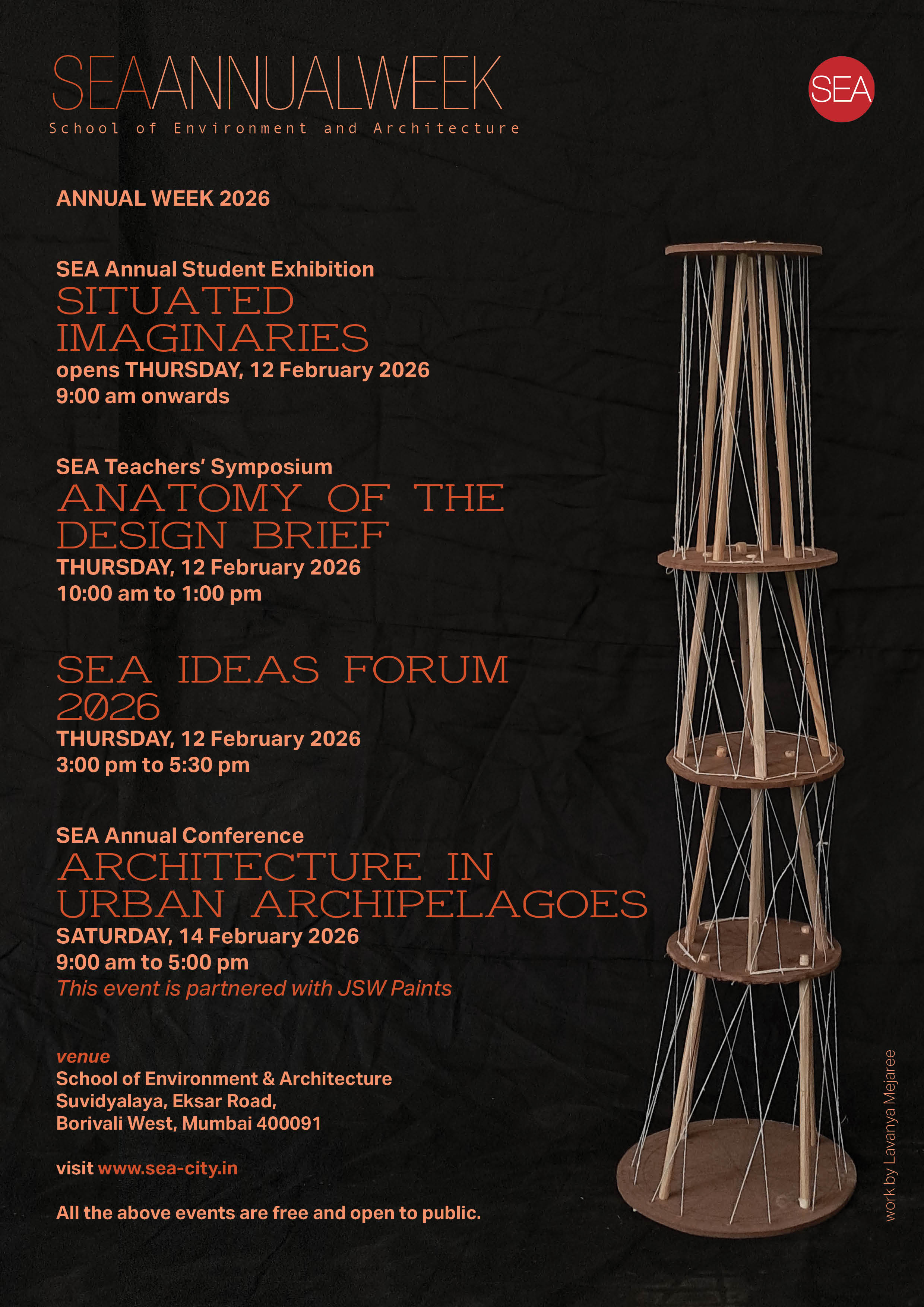
SEA Annual Week 2026
Public Events
Public Events
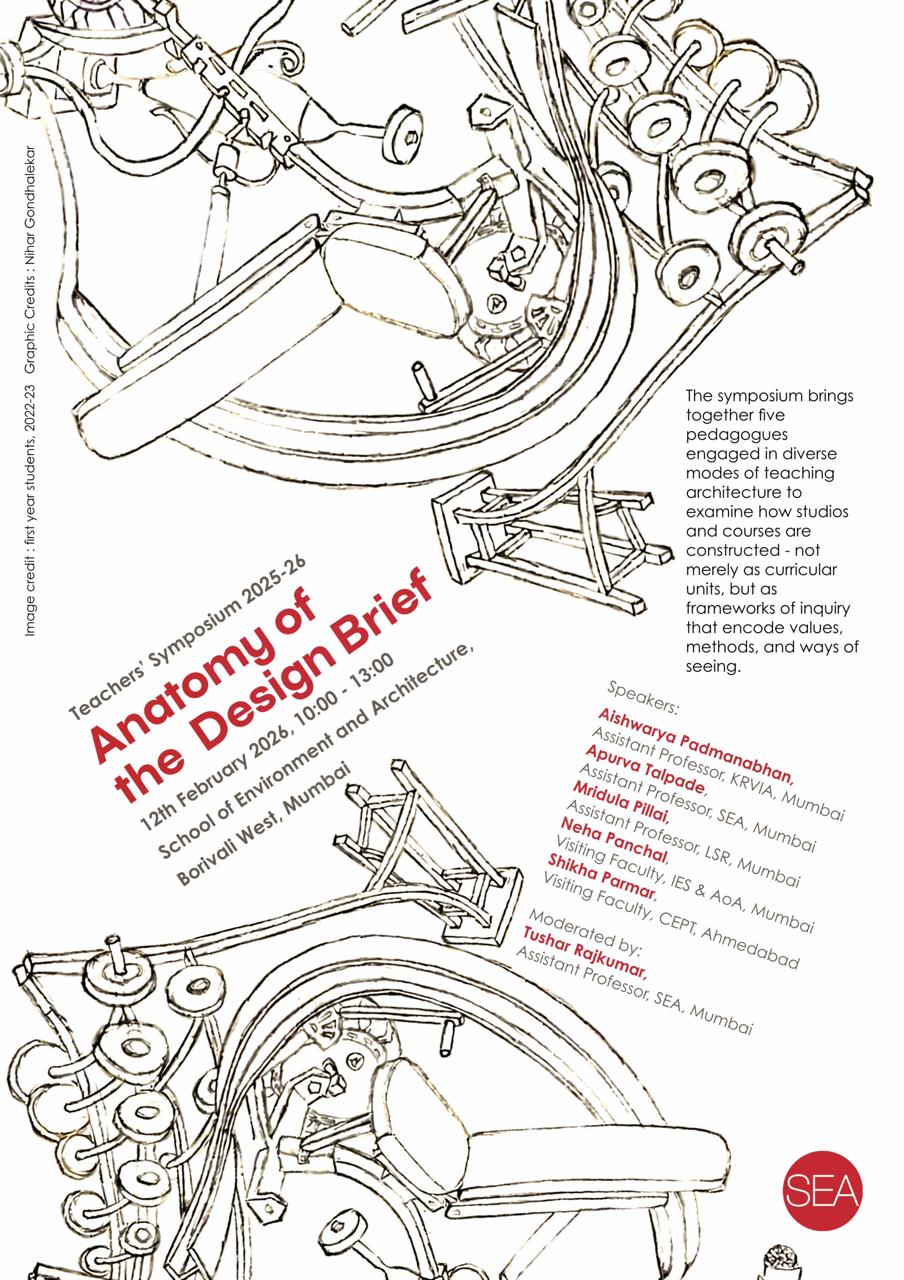
SEA Teachers’ Symosium 2026
ANATOMY OF THE DESIGN BRIEF
on Thursday,
12 February 2026
10:00 am to 1:00 pm
Read more...
ANATOMY OF THE DESIGN BRIEF
on Thursday,
12 February 2026
10:00 am to 1:00 pm
Read more...
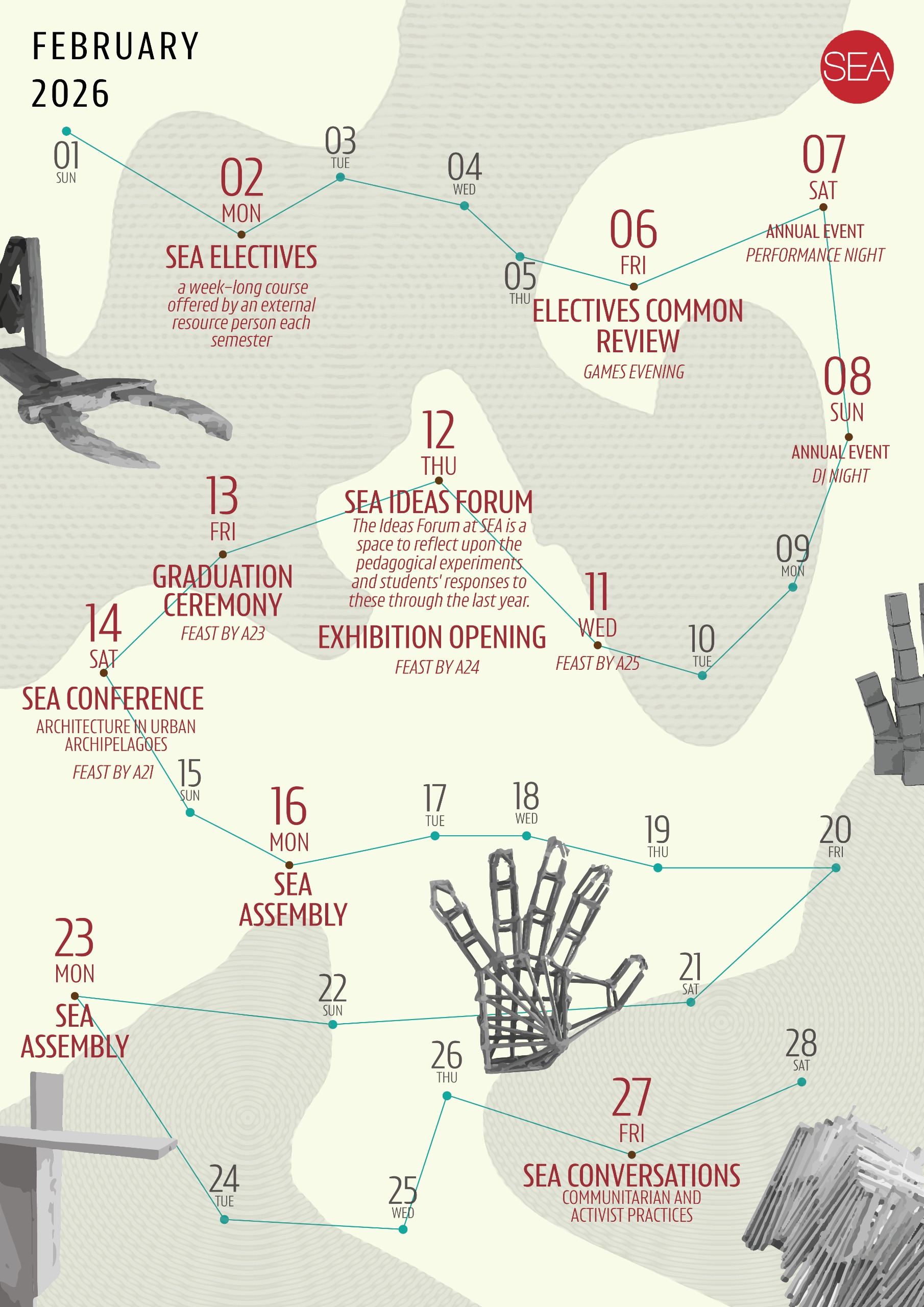
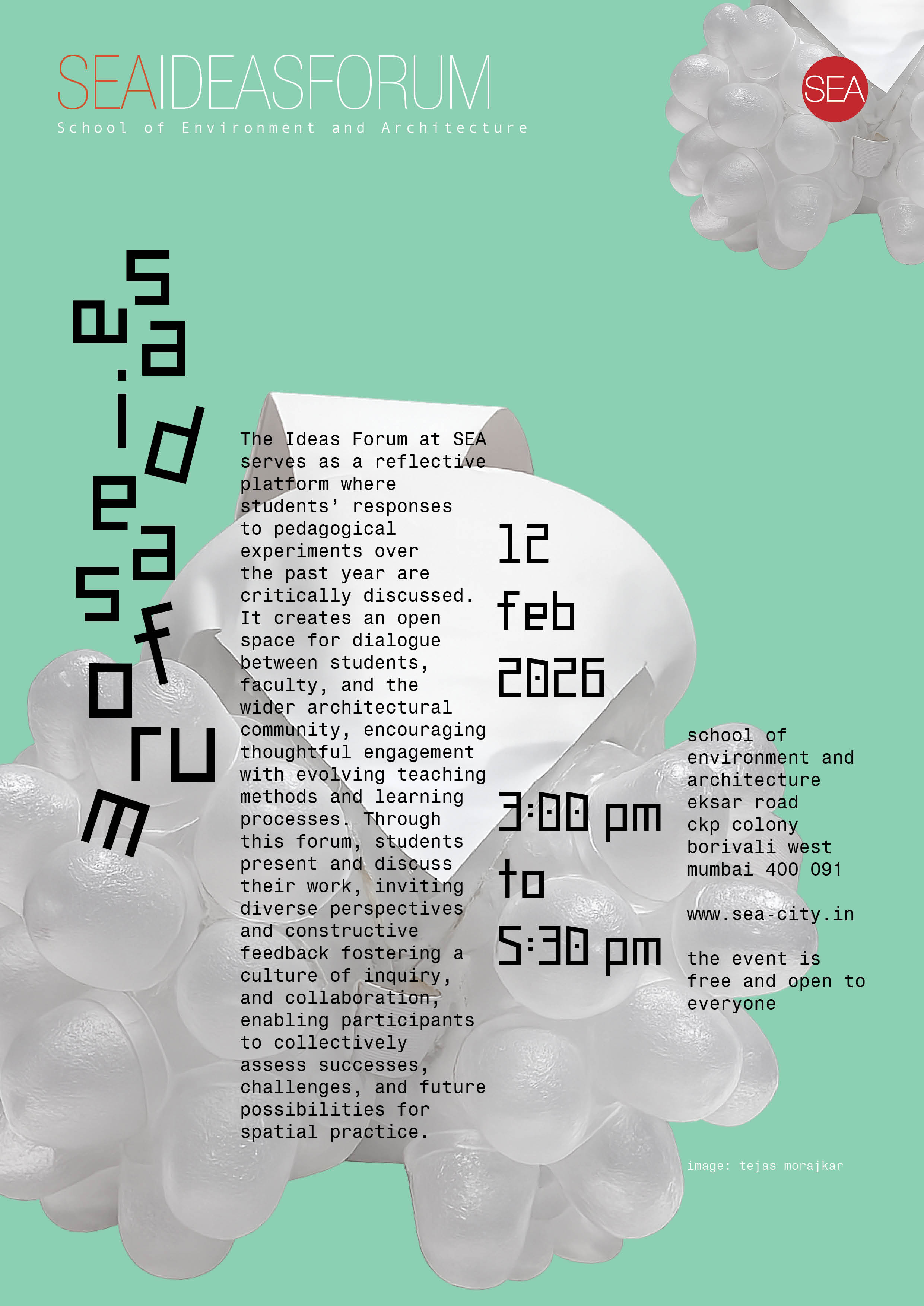
February 2026 at SEA
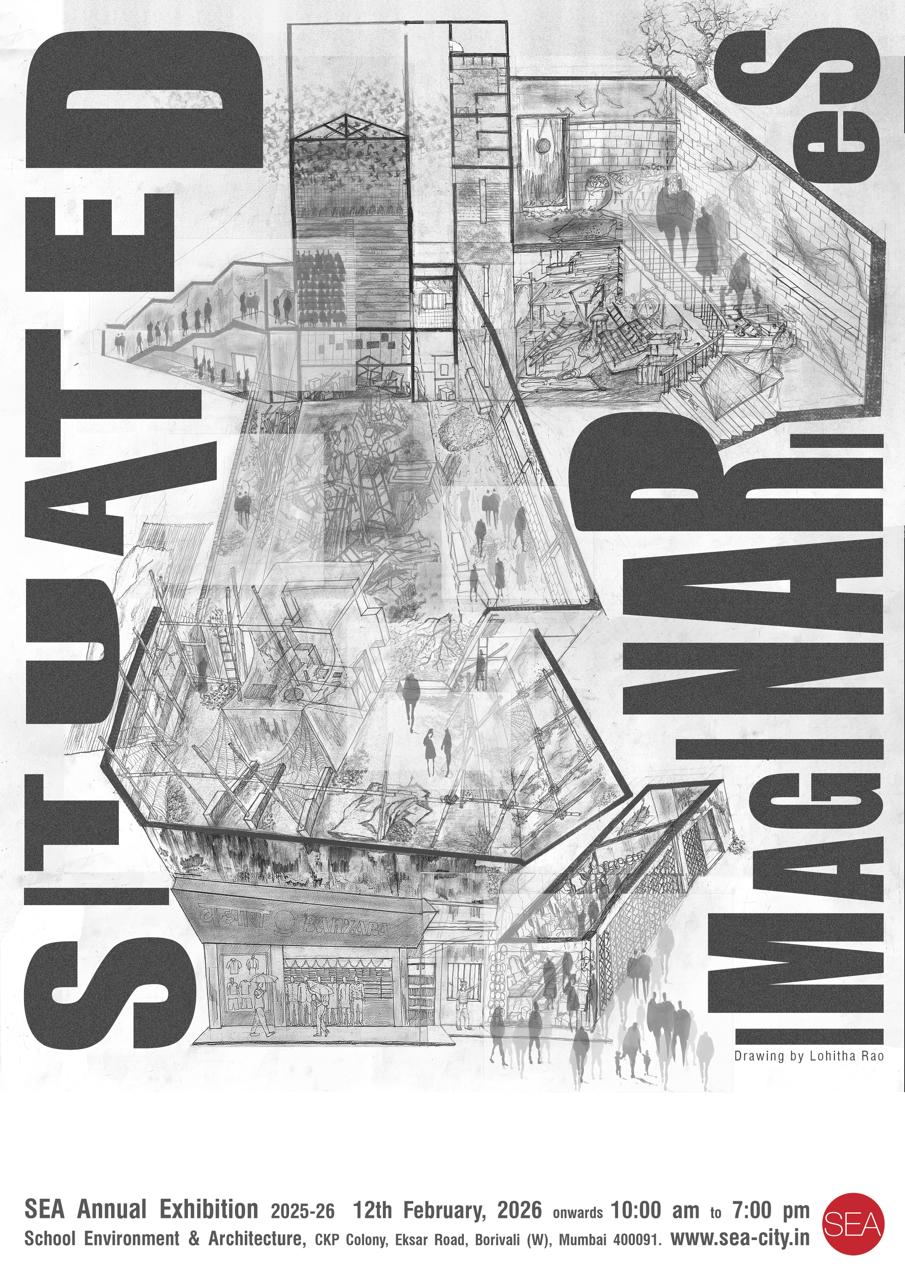
SEA Annual Student Exhibition
SITUATED IMAGINARIES
opens THURSDAY,
12 February 2026
9:00 am onwards
Read more...
SITUATED IMAGINARIES
opens THURSDAY,
12 February 2026
9:00 am onwards
Read more...
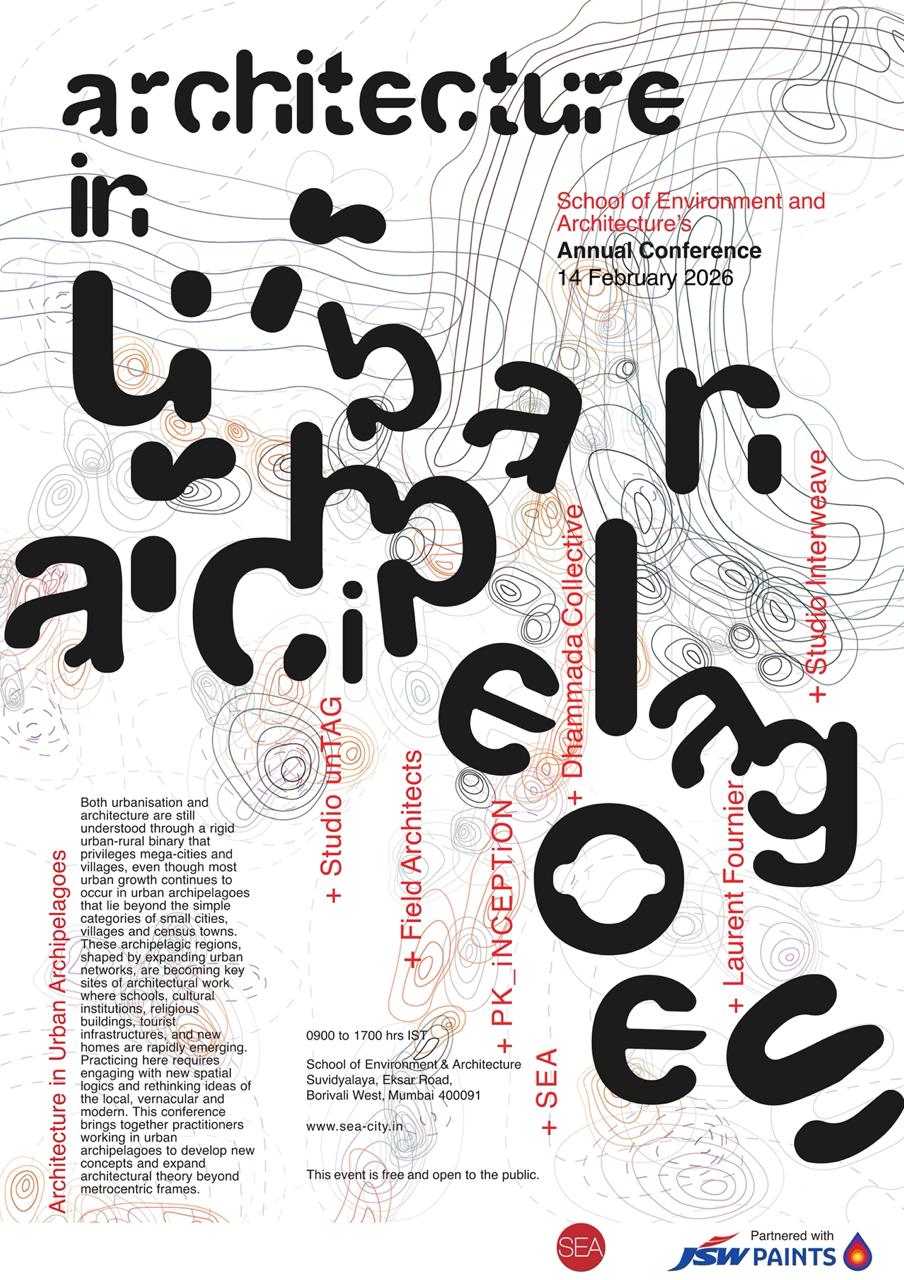
SEA Annual Conference 2026
ARCHITECTURE IN URBAN ARCHIPELAGOES
on Saturday,
14 February 2026
9:00 am to 5:00 pm
Read more...
ARCHITECTURE IN URBAN ARCHIPELAGOES
on Saturday,
14 February 2026
9:00 am to 5:00 pm
Read more...