SEA Annual Conference 2026
Saturday,
14 February 2026
9:00 am to 5:00 pm
9:00 am to 5:00 pm
Architecture in Urban Archipelagoes
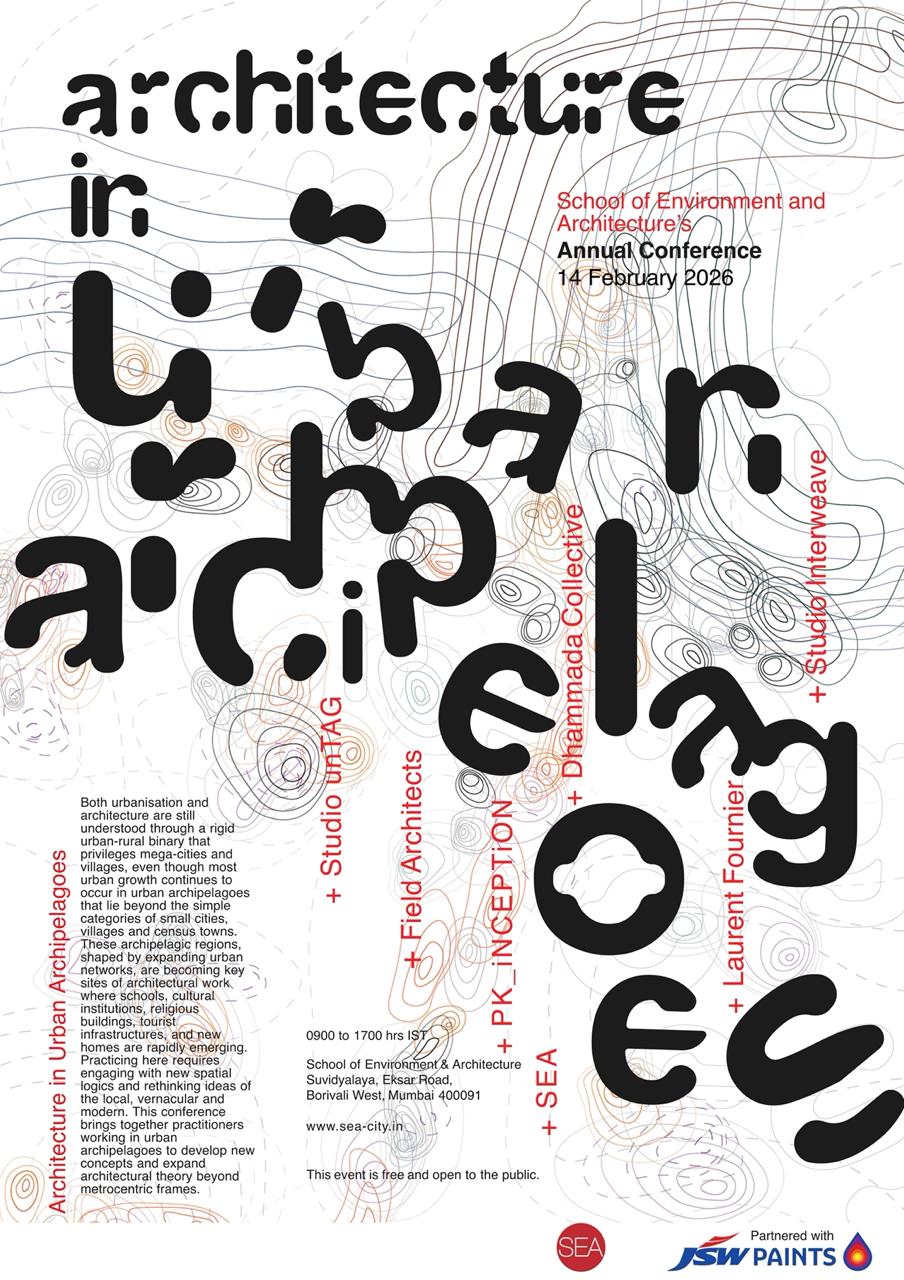
Much of our thinking about urbanisation and architecture still remains grounded in a strict urban/rural binary, where attention is mostly given to mega-cities, large cities, second cities, and, on the other side, to “villages.” Yet most urban growth has always been taking place in what are officially labeled “other cities,” “villages,” and “census towns,” based only on their demographics. These places are neither fully urban nor rural. They do not fit standard categories and have been developing through their own grammar and processes, shaped by expanding networks and flows of urbanisation across the country and even the planet.
These archipelagic spaces are now becoming central to new architectural practices and interventions. For example, Asia’s largest church is located not in a major city but in the small town of Zünheboto in Nagaland. While many projects by trained architects involve “second homes,” architectural practices are increasingly entering competitions and building in non/urban areas. Schools, cultural institutions, religious buildings, tourist infrastructures, community centers, and factories are now emerging across these regions as both state and private capital and infrastructures move through them. New homes are being built, not as second residences, but as homes for native residents who now live elsewhere, often in cities, with close ties to these places.
Practicing architecture here means working with new spatial logics, actors, and agencies, and rethinking terms such as “local,” “vernacular,” “traditional,” and even “modern,” which is often assumed to mean urban. In this context, the conference seeks to bring together practitioners working in these (non)urban archipelagoes to ask new architectural questions, explore new forms of practice, and develop new spatial concepts, while also extending familiar ones that have remained unchallenged and metrocentric. The larger aim is to understand what is happening in these regions, build a set of architectural references and sources grounded in their practices, and expand architectural theory beyond its metrocentric focus.
This event is free and open to public.
Download Programme Booklet
Much of our thinking about urbanisation and architecture still remains grounded in a strict urban/rural binary, where attention is mostly given to mega-cities, large cities, second cities, and, on the other side, to “villages.” Yet most urban growth has always been taking place in what are officially labeled “other cities,” “villages,” and “census towns,” based only on their demographics. These places are neither fully urban nor rural. They do not fit standard categories and have been developing through their own grammar and processes, shaped by expanding networks and flows of urbanisation across the country and even the planet.
These archipelagic spaces are now becoming central to new architectural practices and interventions. For example, Asia’s largest church is located not in a major city but in the small town of Zünheboto in Nagaland. While many projects by trained architects involve “second homes,” architectural practices are increasingly entering competitions and building in non/urban areas. Schools, cultural institutions, religious buildings, tourist infrastructures, community centers, and factories are now emerging across these regions as both state and private capital and infrastructures move through them. New homes are being built, not as second residences, but as homes for native residents who now live elsewhere, often in cities, with close ties to these places.
Practicing architecture here means working with new spatial logics, actors, and agencies, and rethinking terms such as “local,” “vernacular,” “traditional,” and even “modern,” which is often assumed to mean urban. In this context, the conference seeks to bring together practitioners working in these (non)urban archipelagoes to ask new architectural questions, explore new forms of practice, and develop new spatial concepts, while also extending familiar ones that have remained unchallenged and metrocentric. The larger aim is to understand what is happening in these regions, build a set of architectural references and sources grounded in their practices, and expand architectural theory beyond its metrocentric focus.
This event is free and open to public.
Download Programme Booklet
PROGRAMME
09:00 - 09:15
Introduction Prasad Khanolkar, SEA
09:00 - 09:15
Introduction Prasad Khanolkar, SEA
09:15 - 11:15 | Session 01
This session will reflect on how architectural practices locate and theorise their work within urban archipelagoes. It will examine the processes and spatial logics that shape practice in these complex contexts, the challenges of working across unfamiliar terrains, and the nature of relationships with clients and communities. The discussion will also consider what it means for communities to receive formal architectural expertise, the architectural concepts that may need rethinking, and how practicing in these locations can inform future directions for architectural theory, pedagogy, and practice.
chair & moderation
Prasad Khanolkar (SEA)
speakers
Pooja Khairnar (PK_iNCEPTiON)
Suril Patel (Field Architects)
Rohit Mujumdar (SEA)
Finding New Grounds
This session will reflect on how architectural practices locate and theorise their work within urban archipelagoes. It will examine the processes and spatial logics that shape practice in these complex contexts, the challenges of working across unfamiliar terrains, and the nature of relationships with clients and communities. The discussion will also consider what it means for communities to receive formal architectural expertise, the architectural concepts that may need rethinking, and how practicing in these locations can inform future directions for architectural theory, pedagogy, and practice.
chair & moderation
Prasad Khanolkar (SEA)
speakers
Pooja Khairnar (PK_iNCEPTiON)
Suril Patel (Field Architects)
Rohit Mujumdar (SEA)
11:45 - 13:45 | Session 02
This session will explore contemporary approaches to habitation in diverse and emerging contexts, asking who inhabits these spaces and how architects engage with the inhabitants. It will examine the spatial logics of habitation that shape practice, the role of materials, technologies, labour, and construction processes, and how architectural “types” are adapted or reworked. The discussion will also reflect on how questions of gender, class, and environment are negotiated, and how current practices draw from, depart from, or reframe older architectural theories, offering new directions for architectural pedagogy and practice.
chair & moderation
Anuj Daga (SEA)
speakers
Upendra Gurung (Studio INTERWEAVE)
Gauri Satam & Tejesh Patil (Studio unTAG)
Rupali Gupte (SEA)
Grammars of Habitation
This session will explore contemporary approaches to habitation in diverse and emerging contexts, asking who inhabits these spaces and how architects engage with the inhabitants. It will examine the spatial logics of habitation that shape practice, the role of materials, technologies, labour, and construction processes, and how architectural “types” are adapted or reworked. The discussion will also reflect on how questions of gender, class, and environment are negotiated, and how current practices draw from, depart from, or reframe older architectural theories, offering new directions for architectural pedagogy and practice.
chair & moderation
Anuj Daga (SEA)
speakers
Upendra Gurung (Studio INTERWEAVE)
Gauri Satam & Tejesh Patil (Studio unTAG)
Rupali Gupte (SEA)
14:45 - 16:45 | Session 03
This session will reflect on how architectural practices working in urban archipelagos define and situate themselves within the longer histories of practice in India, and how they have evolved over time. It will examine whether working in such contexts demands different modes of practice, shaped by context, actors, materials, technologies, labour, and finances. The discussion will also focus on experimentations in materials, technologies, collectives, and outputs, including multi-modal practices spanning building, research, teaching, and production. Finally, the session will speculate on future directions of architectural practice and their implications for architectural theory and pedagogy.
chair & moderation
Dushyant Asher (SEA)
speakers
Laurent Fournier (Independent Architect)
Nipun Prabhakar (Dhammada Collective)
Prasad Shetty (SEA)
16:45 - 17:00 | Closing Remarks
Modalities of Practice
This session will reflect on how architectural practices working in urban archipelagos define and situate themselves within the longer histories of practice in India, and how they have evolved over time. It will examine whether working in such contexts demands different modes of practice, shaped by context, actors, materials, technologies, labour, and finances. The discussion will also focus on experimentations in materials, technologies, collectives, and outputs, including multi-modal practices spanning building, research, teaching, and production. Finally, the session will speculate on future directions of architectural practice and their implications for architectural theory and pedagogy.
chair & moderation
Dushyant Asher (SEA)
speakers
Laurent Fournier (Independent Architect)
Nipun Prabhakar (Dhammada Collective)
Prasad Shetty (SEA)
16:45 - 17:00 | Closing Remarks