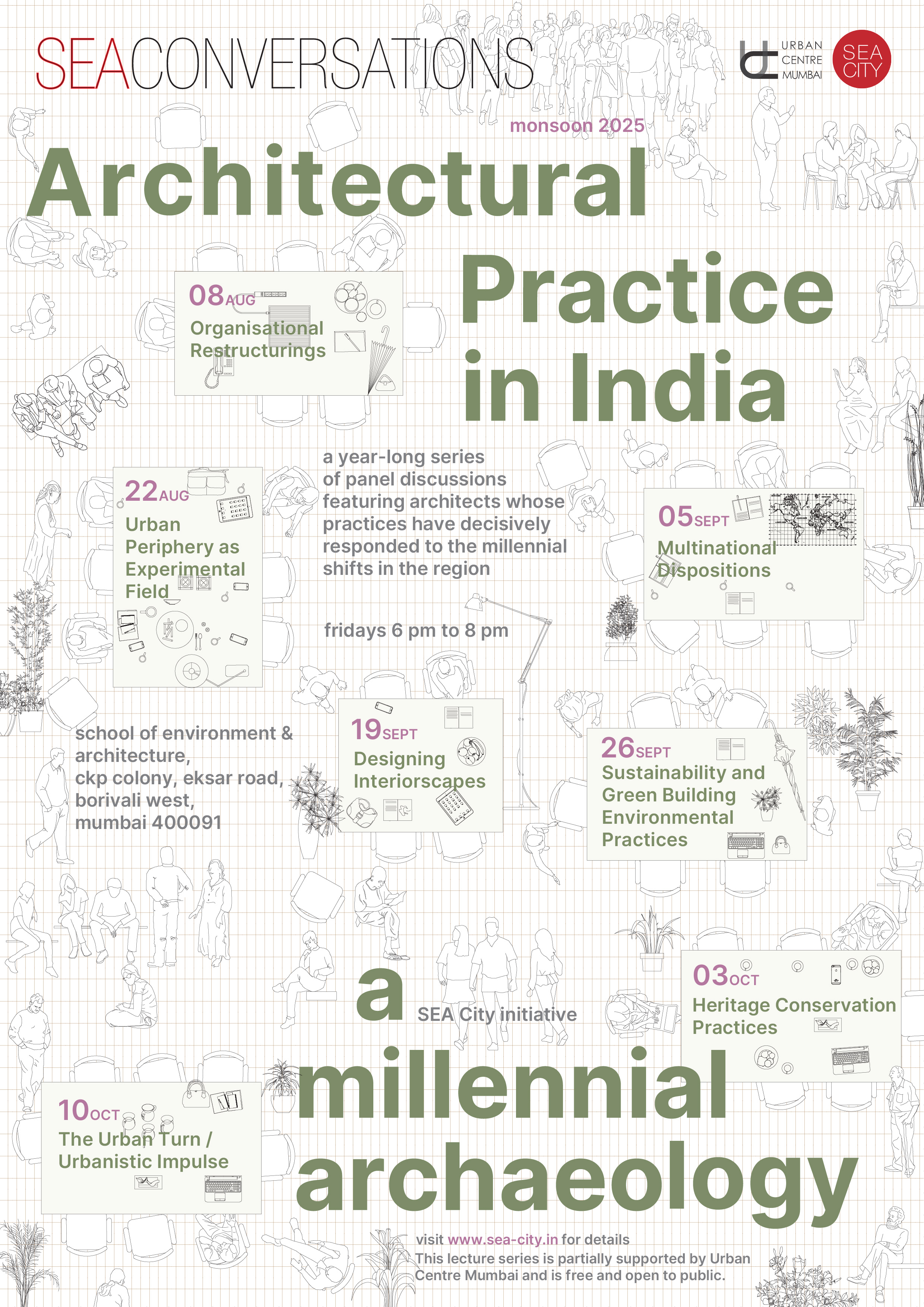
Architectural Practice In India: A Millennial Archaeology - Part 1
At the threshold of the first quarter of the millennium, which also marks a generation since India’s economic liberalization, architectural practice in India is ripe for a critical re-evaluation. In this period, the country has gradually, yet starkly shifted from a socialist framework to a neoliberal state, where developmental politics has ramified architectural production into new directions and logics. Existing scholarship on the built environment in India has often focused narrowly on the aesthetics of form, the evolving identity of the architect, or the reception of modernism as inherited from the West. Architectural discourse has largely taken one of two paths: either documenting work deemed academically significant, or framing emerging practices in terms of identity—often measured against binaries such as modern versus indigenous/vernacular. Such approaches tend to posit the architect as a servant of academic canons or fixed ideals.
Architectural practice on the ground, as it appears now, is far more complex - one that exhibits reorientation of spatial ideals and values to reflect a rapidly evolving society increasingly shaped by media, consumerism, and aspirations of globalisation. Once trained architects step into the field, the idealism of modernism is quickly refracted through geopolitical urgencies and the pragmatic demands of practice. What is often overlooked is the inherent political exigency that compels practice to adapt—making the operations and expressions of architecture more malleable and responsive to emerging needs of the market - in its widest extensions. In such contexts, architects evolve new formats, languages, agencies, and strategies to negotiate their professional knowledge to remain relevant within the real-world demands of building reinterpreting spatial briefs through the vocabularies of capital, conservation, environment, real estate, and more.
‘Architectural Practice in India: A Millennial Archaeology’ seeks to examine how architectural practice in India has developed over the last three decades within the framework of the millennial shift in its political economy. What forces—of power, ambition, and institutional pressure—have shaped architectural production during this period and how does it reorganise the delivery of the built environment? What aspects of practice gain currency in the emerging market and how does the professional architect find reconciliations and directions in addressing these. In excavating these variegated forms of practice that shape the unevenness of our built landscape today, these discussions aim to explore tendencies such as the rise of managerial approach, the renewed focus on environmental and heritage concerns, the emergence of artisanal and communitarian agendas, the urgency of urbanistic thinking, response to media and the integration of computational and digital thinking that come to constitute distinct, yet composite strands of spatial practice today.
The new cycle of SEA City Conversations is conceived as a year-long series of panel discussions featuring architects and spatial commentators, whose own practices have decisively responded to the millennial shifts in the region, by means of slipping, fitting or pushing the envelopes of conventional formats of practice. Methodologically, the series will draw upon the professional biographies of practitioners from across the city whose trajectories have remained representatively pivotal in bringing and operating in such changing dynamics of practice. Through reflexive interrogation and collective debate over the upcoming year, the programme imagines to present itself as an open course for the city, and invite the public to participate in a collective architecture history-writing exercise that seeks to critically engage with the evolving realities of contemporary architecture in India.
sessions
Aug 08 Organisational Restructurings
Aug 22 Urban Periphery as Experimental Field
Sep 05 Multinational Dispositions
Sep 19 Designing Interiorscapes
Sep 26 Sustainability & Green Building Environmental Practices
Oct 03 Heritage Conservation Practices
Oct 10 The Urban Turn / Urbanistic Impulse
Architectural practice on the ground, as it appears now, is far more complex - one that exhibits reorientation of spatial ideals and values to reflect a rapidly evolving society increasingly shaped by media, consumerism, and aspirations of globalisation. Once trained architects step into the field, the idealism of modernism is quickly refracted through geopolitical urgencies and the pragmatic demands of practice. What is often overlooked is the inherent political exigency that compels practice to adapt—making the operations and expressions of architecture more malleable and responsive to emerging needs of the market - in its widest extensions. In such contexts, architects evolve new formats, languages, agencies, and strategies to negotiate their professional knowledge to remain relevant within the real-world demands of building reinterpreting spatial briefs through the vocabularies of capital, conservation, environment, real estate, and more.
‘Architectural Practice in India: A Millennial Archaeology’ seeks to examine how architectural practice in India has developed over the last three decades within the framework of the millennial shift in its political economy. What forces—of power, ambition, and institutional pressure—have shaped architectural production during this period and how does it reorganise the delivery of the built environment? What aspects of practice gain currency in the emerging market and how does the professional architect find reconciliations and directions in addressing these. In excavating these variegated forms of practice that shape the unevenness of our built landscape today, these discussions aim to explore tendencies such as the rise of managerial approach, the renewed focus on environmental and heritage concerns, the emergence of artisanal and communitarian agendas, the urgency of urbanistic thinking, response to media and the integration of computational and digital thinking that come to constitute distinct, yet composite strands of spatial practice today.
The new cycle of SEA City Conversations is conceived as a year-long series of panel discussions featuring architects and spatial commentators, whose own practices have decisively responded to the millennial shifts in the region, by means of slipping, fitting or pushing the envelopes of conventional formats of practice. Methodologically, the series will draw upon the professional biographies of practitioners from across the city whose trajectories have remained representatively pivotal in bringing and operating in such changing dynamics of practice. Through reflexive interrogation and collective debate over the upcoming year, the programme imagines to present itself as an open course for the city, and invite the public to participate in a collective architecture history-writing exercise that seeks to critically engage with the evolving realities of contemporary architecture in India.
sessions
Aug 08 Organisational Restructurings
Aug 22 Urban Periphery as Experimental Field
Sep 05 Multinational Dispositions
Sep 19 Designing Interiorscapes
Sep 26 Sustainability & Green Building Environmental Practices
Oct 03 Heritage Conservation Practices
Oct 10 The Urban Turn / Urbanistic Impulse
session 1
Organisational Restructurings
Friday, August 08, 2025 at 6:00 PM IST
Economic liberalization of the 1990s in India promoted market-oriented reforms, privatization, and moderated the control of state over developmental processes. Such conditions triggered an infrastructure boom, with the private sectors initiating large-scale projects across urban landscapes in India. Amidst the proliferation of special economic zones, BPOs, five star hotels, airports, malls and townships, architectural practice in India began to assume a managerial impetus, focusing upon the logics of functional efficiency in large scale project delivery and building serviceability. International capital came to fundamentally rescript architectural practice in its outlook and operations. In this panel, we bring three representative practices to open up: how have architectural firms transitioned into the delivery of megaprojects? How does the architect’s office reconfigure and organise itself to the shift in scale? What new protocols get put in place and how does it impact the relationship between the architect and the field?
discussants
Ravi Sarangan (Edifice Consultants)
Brinda Somaya (Somaya+Sampat)
Ratan Batliboi (RJB-CPL)
moderated by Ravindra Punde (SEA, Design Cell)
venue
School of Environment & Architecture
CKP Colony, Eskar Road, Borivali West, Mumbai 400 091
The event is partly supported by Urban Centre Mumbai.
It is free and open to everyone across the world.
discussants
Ravi Sarangan (Edifice Consultants)
Brinda Somaya (Somaya+Sampat)
Ratan Batliboi (RJB-CPL)
moderated by Ravindra Punde (SEA, Design Cell)
venue
School of Environment & Architecture
CKP Colony, Eskar Road, Borivali West, Mumbai 400 091
The event is partly supported by Urban Centre Mumbai.
It is free and open to everyone across the world.

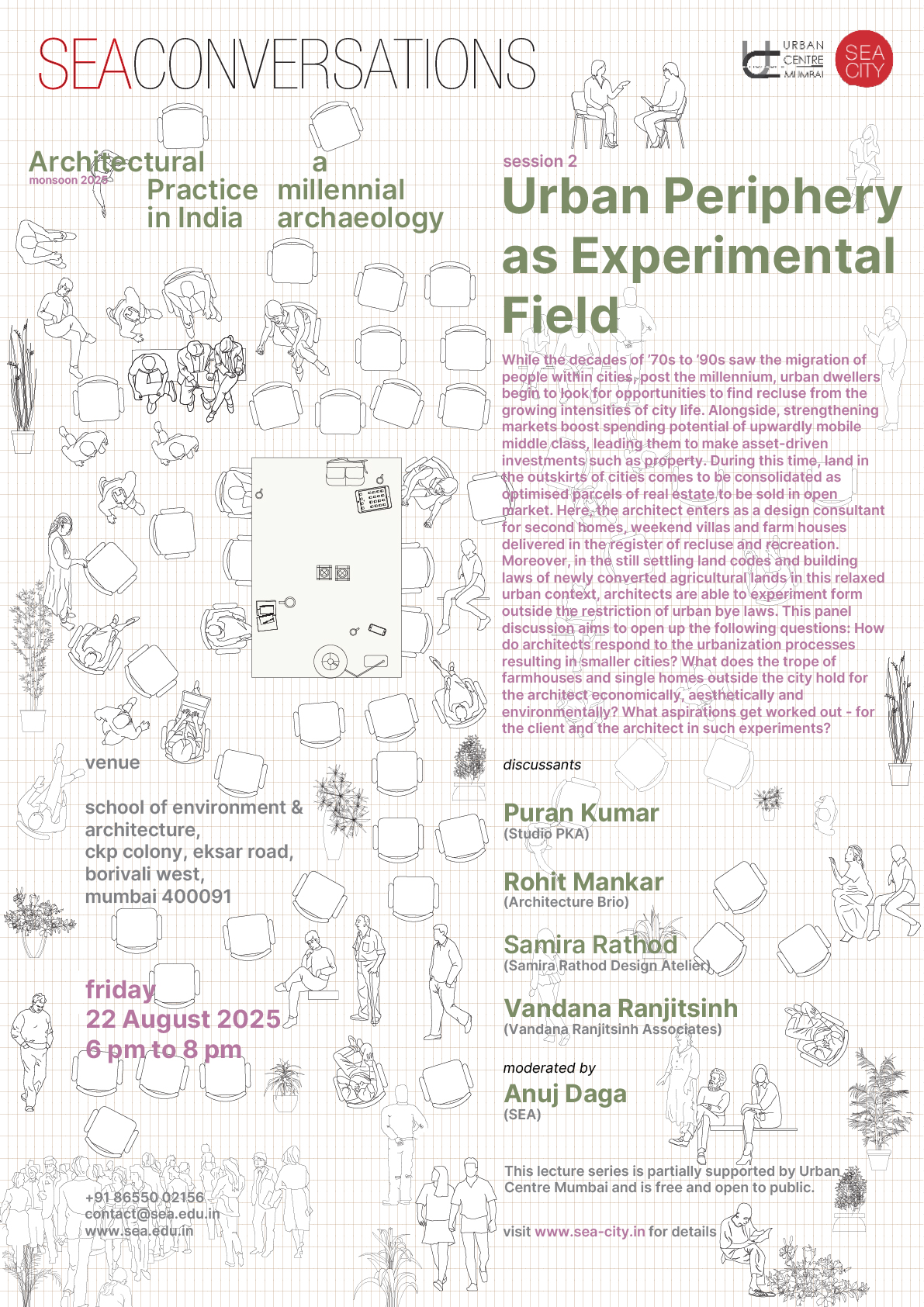
session 2
Urban Periphery as Experimental Field
Friday, August 22, 2025 at 6:00 PM IST
While the decades of ’70s to ’90s saw the migration of people within cities, post the millennium, urban dwellers began to look for opportunities to find recluse from the growing intensities of city life. Alongside, strengthening markets boost spending potential of upwardly mobile middle class, leading them to make asset-driven investments such as property. During this time, land in the outskirts of cities comes to be consolidated as optimised parcels of real estate to be sold in the open market. Here, the architect enters as a design consultant for second homes, weekend villas and farmhouses delivered in the register of recluse and recreation. Moreover, in the still settling land codes and building laws of newly converted agricultural lands in this relaxed urban context, architects are able to experiment form outside the restriction of urban bye laws. This panel discussion aims to open up the following questions: How do architects respond to the urbanization processes resulting in smaller cities? What does the trope of farmhouses and single homes outside the city hold for the architect economically, aesthetically and environmentally? What aspirations get worked out - for the client and the architect in such experiments?
discussants
Puran Kumar (Studio PKA)
Samira Rathod (Samira Rathod Design Atelier)
Rohit Mankar (Architecture Brio)
Vandana Ranjitsinh (Ranjitsinh and Associates)
moderated by Anuj Daga, SEA
venue
School of Environment & Architecture
CKP Colony, Eskar Road, Borivali West, Mumbai 400 091
The event is partly supported by Urban Centre Mumbai.
It is free and open to everyone across the world.
discussants
Puran Kumar (Studio PKA)
Samira Rathod (Samira Rathod Design Atelier)
Rohit Mankar (Architecture Brio)
Vandana Ranjitsinh (Ranjitsinh and Associates)
moderated by Anuj Daga, SEA
venue
School of Environment & Architecture
CKP Colony, Eskar Road, Borivali West, Mumbai 400 091
The event is partly supported by Urban Centre Mumbai.
It is free and open to everyone across the world.
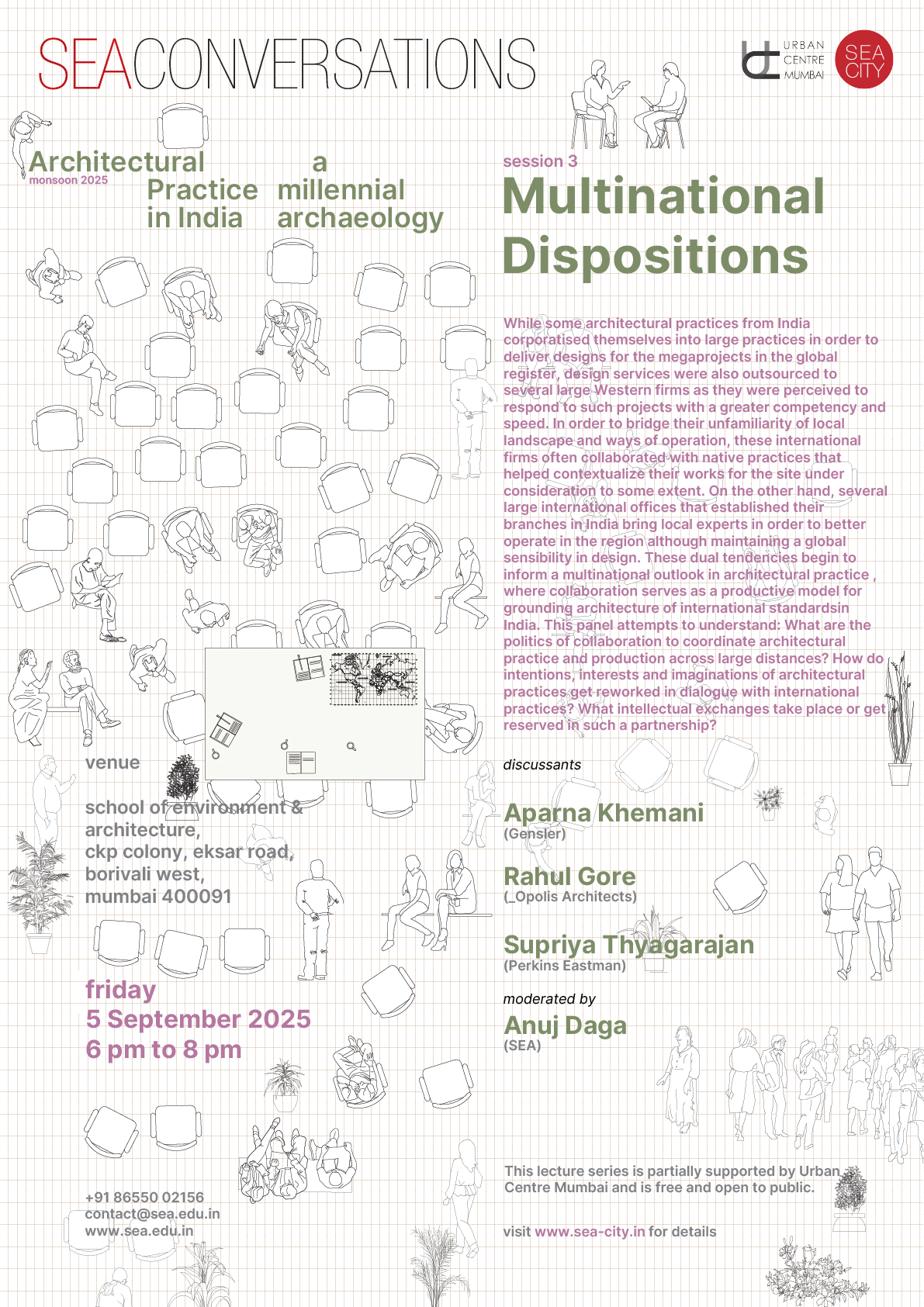
session 3
Multinational Dispositions
Friday, September 5, 2025 at 6:00 PM IST
While some architectural practices from India corporatised themselves into large practices in order to deliver designs for the megaprojects in the global register, design services were also outsourced to several large Western firms as they were perceived to respond to such projects with a greater competency and speed. In order to bridge their unfamiliarity of local landscape and ways of operation, these international firms often collaborated with native practices that helped contextualize their works for the site under consideration to some extent. On the other hand, several large international offices that established their branches in India bring local experts in order to better operate in the region although maintaining a global sensibility in design. These dual tendencies begin to inform a multinational outlook in architectural practice , where collaboration serves as a productive model for grounding architecture of international standardsin India. This panel attempts to understand: What are the politics of collaboration to coordinate architectural practice and production across large distances? How do intentions, interests and imaginations of architectural practices get reworked in dialogue with international practices? What intellectual exchanges take place or get reserved in such a partnership?
discussants
Aparna Khemani (Gensler)
Rahul Gore (_Opolis Architects)
Supriya Thyagarajan (Perkins Eastman)
moderated by Anuj Daga, SEA
venue
School of Environment & Architecture
CKP Colony, Eskar Road, Borivali West, Mumbai 400 091
The event is partly supported by Urban Centre Mumbai.
It is free and open to everyone across the world.
discussants
Aparna Khemani (Gensler)
Rahul Gore (_Opolis Architects)
Supriya Thyagarajan (Perkins Eastman)
moderated by Anuj Daga, SEA
venue
School of Environment & Architecture
CKP Colony, Eskar Road, Borivali West, Mumbai 400 091
The event is partly supported by Urban Centre Mumbai.
It is free and open to everyone across the world.
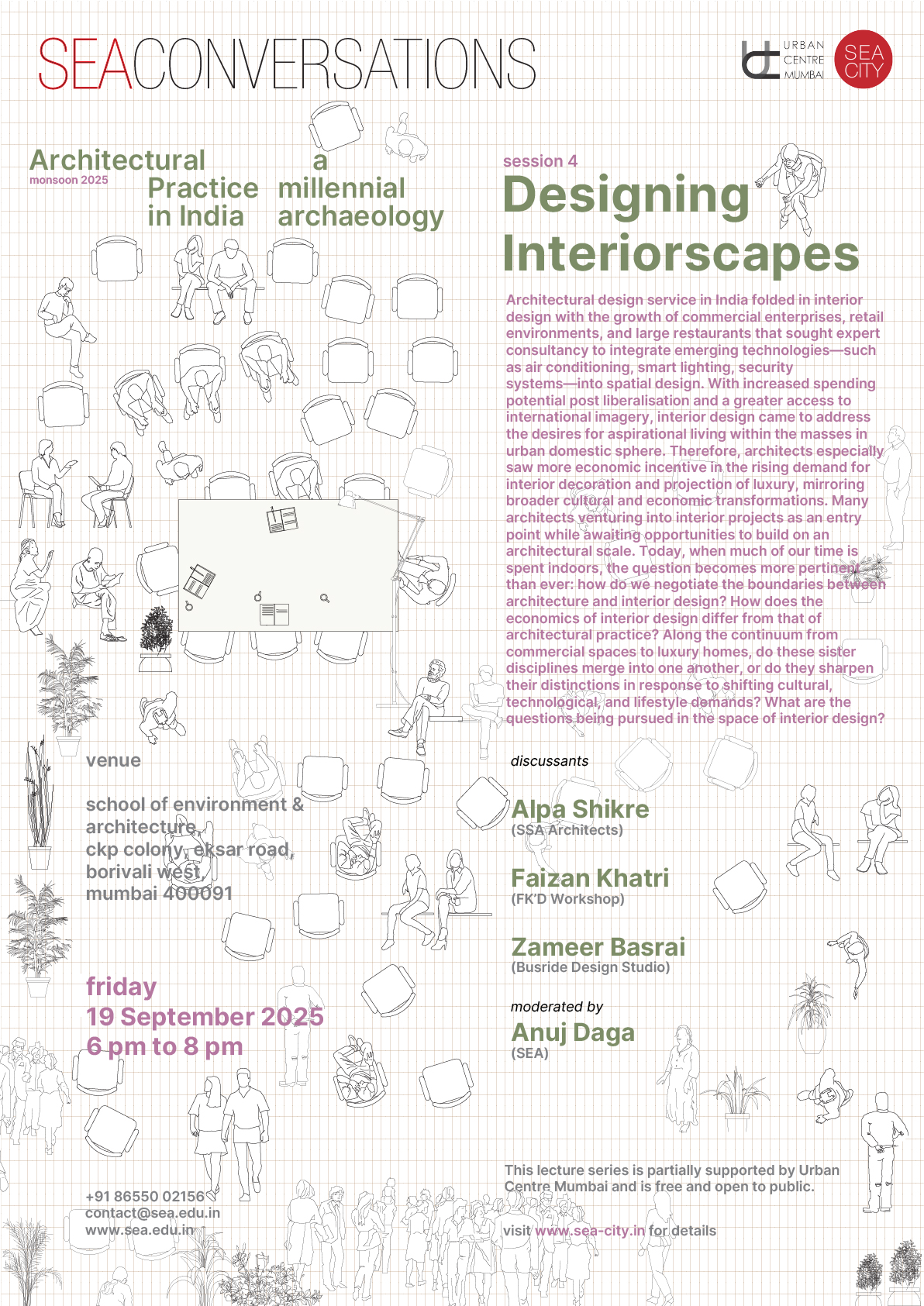
session 4
Designing Interiorscapes
Friday, September 19, 2025 at 6:00 PM IST
Architectural design service in India began extending to interior design with the growth of commercial enterprises, retail environments, and large restaurants that sought expert consultancy to integrate emerging technologies—such as air conditioning, smart lighting, security systems, and audiovisual elements—into spatial design. With increased spending potential post liberalisation and a greater access to international imagery, interior design came to address the desires for aspirational living within the masses in urban domestic sphere. Therefore, architects especially saw more economic incentive in the rising demand for interior decoration and projection of luxury, mirroring broader cultural and economic transformations. Through the 2000s, the volume of interior design work multiplied, with many architects venturing into interior projects as an entry point while awaiting opportunities to build on an architectural scale. Today, when much of our time is spent indoors, the question becomes more pertinent than ever: how do we negotiate the boundaries between architecture and interior design? How does the economics of interior design differ from that of architectural practice? What technological and artistic reorientations occur in the architect’s office to accommodate this shift? Along the continuum from commercial spaces to luxury homes, do these sister disciplines merge into one another, or do they sharpen their distinctions in response to shifting cultural, technological, and lifestyle demands? What are the questions being pursued in the space of interior design?
discussants
Alpa Shikre (SSA Architects)
Faizan Khatri (FK’D Workshop)
Zameer Basrai (Busride Design Studio)
moderated by Anuj Daga, SEA
venue
School of Environment & Architecture
CKP Colony, Eskar Road, Borivali West, Mumbai 400 091
The event is partly supported by Urban Centre Mumbai.
It is free and open to everyone across the world.
discussants
Alpa Shikre (SSA Architects)
Faizan Khatri (FK’D Workshop)
Zameer Basrai (Busride Design Studio)
moderated by Anuj Daga, SEA
venue
School of Environment & Architecture
CKP Colony, Eskar Road, Borivali West, Mumbai 400 091
The event is partly supported by Urban Centre Mumbai.
It is free and open to everyone across the world.