Architectural Practice In India: A Millennial Archaeology - Part 2
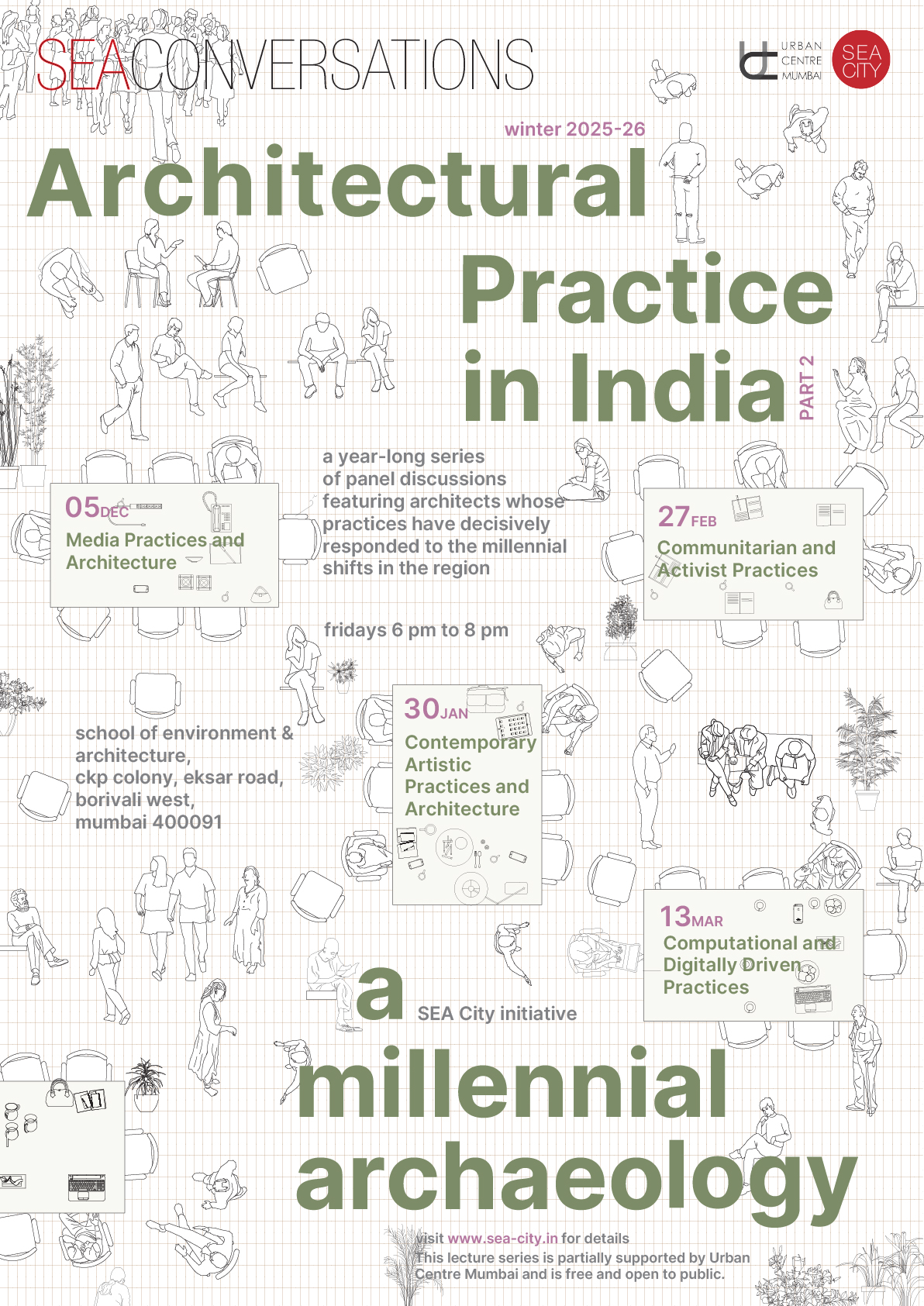
At the threshold of the first quarter of the millennium, which also marks a generation since India’s economic liberalization, architectural practice in India is ripe for a critical re-evaluation. In this period, the country has gradually, yet starkly shifted from a socialist framework to a neoliberal state, where developmental politics has ramified architectural production into new directions and logics. Existing scholarship on the built environment in India has often focused narrowly on the aesthetics of form, the evolving identity of the architect, or the reception of modernism as inherited from the West. Architectural discourse has largely taken one of two paths: either documenting work deemed academically significant, or framing emerging practices in terms of identity—often measured against binaries such as modern versus indigenous/vernacular. Such approaches tend to posit the architect as a servant of academic canons or fixed ideals.
Architectural practice on the ground, as it appears now, is far more complex - one that exhibits reorientation of spatial ideals and values to reflect a rapidly evolving society increasingly shaped by media, consumerism, and aspirations of globalisation. Once trained architects step into the field, the idealism of modernism is quickly refracted through geopolitical urgencies and the pragmatic demands of practice. What is often overlooked is the inherent political exigency that compels practice to adapt—making the operations and expressions of architecture more malleable and responsive to emerging needs of the market - in its widest extensions. In such contexts, architects evolve new formats, languages, agencies, and strategies to negotiate their professional knowledge to remain relevant within the real-world demands of building reinterpreting spatial briefs through the vocabularies of capital, conservation, environment, real estate, and more.
‘Architectural Practice in India: A Millennial Archaeology’ seeks to examine how architectural practice in India has developed over the last three decades within the framework of the millennial shift in its political economy. What forces—of power, ambition, and institutional pressure—have shaped architectural production during this period and how does it reorganise the delivery of the built environment? What aspects of practice gain currency in the emerging market and how does the professional architect find reconciliations and directions in addressing these. In excavating these variegated forms of practice that shape the unevenness of our built landscape today, these discussions aim to explore tendencies such as the rise of managerial approach, the renewed focus on environmental and heritage concerns, the emergence of artisanal and communitarian agendas, the urgency of urbanistic thinking, response to media and the integration of computational and digital thinking that come to constitute distinct, yet composite strands of spatial practice today.
The new cycle of SEA City Conversations is conceived as a year-long series of panel discussions featuring architects and spatial commentators, whose own practices have decisively responded to the millennial shifts in the region, by means of slipping, fitting or pushing the envelopes of conventional formats of practice. Methodologically, the series will draw upon the professional biographies of practitioners from across the city whose trajectories have remained representatively pivotal in bringing and operating in such changing dynamics of practice. Through reflexive interrogation and collective debate over the upcoming year, the programme imagines to present itself as an open course for the city, and invite the public to participate in a collective architecture history-writing exercise that seeks to critically engage with the evolving realities of contemporary architecture in India.
sessions
Dec 05, 2025 Media Practices and Architecture
Jan 30, 2026 Contemporary Artistic Practices & Architecture
Mar 06, 2026 Communitarian & Activist Practices
Mar 13, 2026 Computational & Digitally Driven Practices
Architectural practice on the ground, as it appears now, is far more complex - one that exhibits reorientation of spatial ideals and values to reflect a rapidly evolving society increasingly shaped by media, consumerism, and aspirations of globalisation. Once trained architects step into the field, the idealism of modernism is quickly refracted through geopolitical urgencies and the pragmatic demands of practice. What is often overlooked is the inherent political exigency that compels practice to adapt—making the operations and expressions of architecture more malleable and responsive to emerging needs of the market - in its widest extensions. In such contexts, architects evolve new formats, languages, agencies, and strategies to negotiate their professional knowledge to remain relevant within the real-world demands of building reinterpreting spatial briefs through the vocabularies of capital, conservation, environment, real estate, and more.
‘Architectural Practice in India: A Millennial Archaeology’ seeks to examine how architectural practice in India has developed over the last three decades within the framework of the millennial shift in its political economy. What forces—of power, ambition, and institutional pressure—have shaped architectural production during this period and how does it reorganise the delivery of the built environment? What aspects of practice gain currency in the emerging market and how does the professional architect find reconciliations and directions in addressing these. In excavating these variegated forms of practice that shape the unevenness of our built landscape today, these discussions aim to explore tendencies such as the rise of managerial approach, the renewed focus on environmental and heritage concerns, the emergence of artisanal and communitarian agendas, the urgency of urbanistic thinking, response to media and the integration of computational and digital thinking that come to constitute distinct, yet composite strands of spatial practice today.
The new cycle of SEA City Conversations is conceived as a year-long series of panel discussions featuring architects and spatial commentators, whose own practices have decisively responded to the millennial shifts in the region, by means of slipping, fitting or pushing the envelopes of conventional formats of practice. Methodologically, the series will draw upon the professional biographies of practitioners from across the city whose trajectories have remained representatively pivotal in bringing and operating in such changing dynamics of practice. Through reflexive interrogation and collective debate over the upcoming year, the programme imagines to present itself as an open course for the city, and invite the public to participate in a collective architecture history-writing exercise that seeks to critically engage with the evolving realities of contemporary architecture in India.
sessions
Dec 05, 2025 Media Practices and Architecture
Jan 30, 2026 Contemporary Artistic Practices & Architecture
Mar 06, 2026 Communitarian & Activist Practices
Mar 13, 2026 Computational & Digitally Driven Practices
session 8
Media Practices and Architecture
Friday, 5 December 2025,
6 pm to 8 pm
With the advent of new channels of information flows during the ‘90s such as broadcasting, internet and mobile technologies, architectural ideas came to be consumed in new ways at an increased intensity. Where on the one hand, the first generation architects in India were busily compiling monographs chronicling their oeuvres, new publishing markets emerged fuelling public debates on taste, global influence, and architectural production. After 2000, architecture journalism, independent magazines, and digital platforms amplified commentaries on the built environment in India. Moreover exhibitions gained prominence as discursive sites for staging architecture within the public domain. Institutions such as CEPT Archives, the Kochi Biennale Foundation, have given a distinctive push to architectural imagination within the space of the academy as well as experimental practice. Here, the object of architecture, and the role of architect has been centered more emphatically within the cultural sphere. Large architectural exhibitions over the last two decades such as The State of Architecture, The State of Housing or When is Space? have foregrounded archival thinking, spatial inquiry and public engagement within the architectural process. Across these shifts, media has moved from mere documentation to discourse, from objectifying buildings to mediating their cultural, political, and environmental lives - reshaping how architecture is produced, interpreted, and remembered in India. This panel reflects on how media practices—writing, archiving, and exhibition-making - have been actively partaking in the role of reshaping architectural discourse and spatial production in India.
discussants
Kaiwan Mehta
(curator, cultural theorist, Dean - BSSA)
Nisha Nair
(People Place Project)
Ruturaj Parikh
(Studio Matter)
moderated by
Anuj Daga
(SEA)
This lecture series is partially supported by Urban Centre Mumbai and is free and open to public.
discussants
Kaiwan Mehta
(curator, cultural theorist, Dean - BSSA)
Nisha Nair
(People Place Project)
Ruturaj Parikh
(Studio Matter)
moderated by
Anuj Daga
(SEA)
This lecture series is partially supported by Urban Centre Mumbai and is free and open to public.
session 9
Contemporary Artistic Practices and Architecture
Friday, 30 January 2026,
6 pm to 8 pm
How do architectural practices dialogue with art and shift spatial thinking? As a cultural practice, architects have continued to expand the ambit of spatial thinking through purposeful conversations with artistic modes of thinking and making. Over the last two decades, architecture and art have increasingly engaged new media and technologies, altered sensoriums, contended with ecological precarity, and questions of urban life, identity, and difference. These concerns have reoriented how space is perceived, inhabited, and contested. By locating architecture in artistic enquiry, the talk examines how spatial thinking is reconfigured through experimentation, speculation, and critique rather than solely through problem-solving or functional imperatives. In foregrounding transformations in environmental awareness, urban experience, and mediated perception, the session highlights how engagement with artistic practices enables architecture to remain critically responsive to contemporary conditions. It asks what we mean by the “contemporary” and how this term is shaped by historical shifts in artistic and architectural discourse since the new millennium.
discussants
Rajeev Thakker
(a-RT)
Justine De Penning
(The Architecture Story)
Samira Rathod
(Samira Rathod Design Atelier)
moderated by
Anuj Daga
(SEA)
This lecture series is partially supported by Urban Centre Mumbai and is free and open to public.
discussants
Rajeev Thakker
(a-RT)
Justine De Penning
(The Architecture Story)
Samira Rathod
(Samira Rathod Design Atelier)
moderated by
Anuj Daga
(SEA)
This lecture series is partially supported by Urban Centre Mumbai and is free and open to public.
session 10
Communitarian and Activist Practices
Friday, 6 March 2026,
6 pm to 8 pm
The decentralisation of governance and the liberalisation of state policies in the 1990s opened the development sector to a wider range of actors and practices. While private developers and the real estate sector came to dominate the shaping of the built environment, this period also saw the proliferation of non-governmental organisations, residents’ associations, urban think tanks, advocacy groups, and citizen-based organisations. Through collaborations with state and non-state actors, these groups addressed local civic issues—such as waste management, encroachment, lack of public spaces, and neighbourhood beautification—as well as city-scale concerns, including homelessness, slum demolitions and displacement, gender and space, and contestations around development policies and urban futures.
The practices that emerged ranged from activism and community engagement to journalism, public interest litigation, alternate plans and development mechanisms, and policy advocacy. This panel examines the changing nature of architectural practice by bringing together practitioners who have located themselves meaningfully within this shift, foregrounding questions of equity, access, and justice in urban space, and exploring how dialogue between architecture, activism, and community has reshaped professional roles and modes of engagement for architects.
By asking why this communitarian turn has intensified over the past two decades—and what political possibilities and tensions it carries—the discussion considers new imaginaries of difference, belonging, and participation in the making of the built environment. It reflects on how contemporary practitioners engage critically with notions of community to shape more responsive, ethical, and socially grounded architectural futures.
discussants
Neera Adarkar
(Adarkar Associates)
Shweta Wagh & Hussain Indorewala
(Collective for Spatial Alternatives)
moderated by
Prasad Khanolkar
(SEA)
This lecture series is partially supported by Urban Centre Mumbai and is free and open to public.

session 11
Computational and Digitally Driven Practices
Friday, 13 March 2026,
6 pm to 8 pm
The introduction of computers into architectural practice in India did not simply introduce a new tool; it reshaped the logics through which architecture is conceived, represented, and produced. This talk traces the emergence of computational and digital methods in Indian architectural practice, beginning with the early adoption of drafting and modeling software and the gradual transformation of architectural workflows that followed. Digital tools enabled new possibilities of formal complexity, precision, and visualization, while also altering professional practices and design cultures. The presentation examines how the rise of 3D visualizations, renderings, and immersive media such as AR/VR reshaped architectural representation and the circulation of images within contemporary practice. It also reflects on how computational design intersected with fabrication processes, introducing digitally mediated making through CNC technologies, parametric modeling, and experimental desktop fabrication cultures. These developments have influenced aesthetics, work cultures, and economies of production while also finding strong traction within academic studios and workshops.
The talk shall reflect on how digital tools have transformed spatial articulation, workflows, and design imaginaries, while situating these shifts within broader questions of technological aspiration and global alignment.
discussants
Krishna Murthy
(Folds Design Studio)
Jinal Shah
(Program Chair of Masters in Computational Design and Fabrication at CEPT University)
moderated by
Dushyant Asher
(SEA)
This lecture series is partially supported by Urban Centre Mumbai and is free and open to public.
The talk shall reflect on how digital tools have transformed spatial articulation, workflows, and design imaginaries, while situating these shifts within broader questions of technological aspiration and global alignment.
discussants
Krishna Murthy
(Folds Design Studio)
Jinal Shah
(Program Chair of Masters in Computational Design and Fabrication at CEPT University)
moderated by
Dushyant Asher
(SEA)
This lecture series is partially supported by Urban Centre Mumbai and is free and open to public.
